
September 2, 202615 min read
JLG vs Genie vs Dingli: Which Used Aerial Work Platform Should You Import from China?
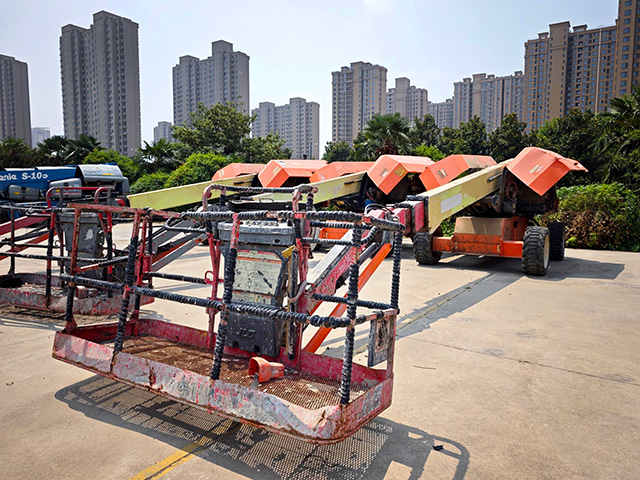
When sourcing used aerial work platforms from China, the three names that dominate every shortlist are JLG, Genie, and Dingli. Each brand occupies a distinct tier — from premium American legacy to Chinese electric-first value — and the right choice depends on your market, fleet strategy, and total cost of ownership. This deep comparison covers specifications, brand DNA, regional fit, and used-unit inspection so you can import with confidence.
Why Brand Matters When Importing Used AWPs from China
A used aerial work platform is a safety-critical machine whose residual value, parts availability, and operator familiarity are almost entirely determined by the badge on the turret. For B2B importers buying from China’s vast used-equipment market, the brand decision affects everything from resale speed in your home country to the cost of a replacement solenoid valve five years later.
JLG and Genie are the two American giants that defined the modern aerial work platform industry, with machines ubiquitous in rental fleets across North America, Europe, and the Middle East. Dingli (Zhejiang Dingli Machinery) is the fastest-growing Chinese manufacturer, a Shanghai-listed company that has bet heavily on full electrification and now exports to over 100 countries. For buyers who want lower acquisition cost without sacrificing CE certification, Dingli is increasingly the value-tier benchmark. New to importing? Our complete guide to the four main AWP types and used aerial work platform buying guide are useful primers.
At a Glance: JLG, Genie, and Dingli
JLG (Oshkosh Corporation since 2006) is the world’s largest AWP manufacturer by revenue. Genie (Terex Corporation since 2002) is its closest rival, dominant in rental-fleet scissor lifts. Dingli (founded 2005, Shanghai-listed 2015, stock code 603338) is China’s leading AWP exporter, with full electrification and a three-year warranty on new machines. JLG and Genie both manufacture in China (Tianjin and Changzhou respectively), while Dingli’s Chinese origin means lower shipping distances and better availability of late-model low-hour units.
Representative Model Specifications Compared
We selected two representative models per brand: one boom lift and one electric scissor lift, covering the most-imported categories. All figures are drawn from manufacturer literature and industry spec sheets; always confirm against the official latest specification sheet for the exact year and configuration.
| Specification | JLG 660SJ (Telescopic Boom) | JLG 1930ES (Electric Scissor) | Genie S-85 (Telescopic Boom) | Genie GS-1932 (Electric Scissor) | Dingli BA24RT (Articulated Boom) | Dingli JCPT1612DC (Electric Scissor) |
|---|---|---|---|---|---|---|
| Platform Height | 20.3 m (66 ft) | 5.72 m (18.8 ft) | 25.9 m (85 ft) | 5.79 m (19 ft) | ~22 m (72 ft) | 14 m (46 ft) |
| Working Height | 22.3 m (73 ft) | 7.72 m (25.3 ft) | 27.9 m (91.5 ft) | 7.79 m (25.6 ft) | ~24 m (79 ft) | 16 m (52.5 ft) |
| Platform Capacity | 250 kg unrestricted | 227 kg | 227 kg | 227 kg | 230 kg | 320 kg |
| Power Type | Diesel, 4WD | Electric (24V DC) | Diesel, 4WD | Electric (24V DC) | Diesel or electric (ERT) | Electric (Li-ion / DC) |
| Machine Weight (approx.) | ~9,700 kg | ~1,370 kg | ~16,300 kg | ~1,480 kg | ~11,500 kg | ~3,200 kg |
| Stowed Length (approx.) | ~10.6 m | ~1.83 m | ~13.0 m | ~1.83 m | ~10.5 m | ~2.5 m |
| Typical Use Case | Construction, outdoor maintenance | Indoor warehousing, fit-out | High-rise construction, stadiums | Indoor retail, offices, data centers | Construction, facility maintenance | Warehousing, logistics, indoor construction |
In the boom-lift class, the JLG 660SJ and Dingli BA24RT are closer in height, while the Genie S-85 is a significantly larger machine — illustrating Genie’s strength in high-reach telescopic booms. In scissors, the Dingli JCPT1612DC offers substantially higher capacity (320 kg) than the comparable JLG and Genie 19-foot units, though it is a much taller 14-meter machine. For a broader scissor comparison, see our top scissor lift brands overview. ASURE stocks several of these exact models, including the JLG 660SJ, JLG 860SJ, Genie S-85, Genie Z-45, Dingli BA24RT, and Dingli JCPT1612.
JLG: The Premium North American Brand
Background and Product Line
JLG Industries was founded in 1969 by John L. Grove in McConnellsburg, Pennsylvania, and has grown into the world’s largest AWP manufacturer by revenue. Acquired by the Oshkosh Corporation in 2006, JLG manufactures in the United States, China (Tianjin), and Europe. Its portfolio is the broadest in the industry: electric and rough-terrain scissors, telescopic booms, articulated booms, mast lifts, and telehandlers. A signature technology is the SkyGuard operator protection system, which stops and reverses machine functions when the control panel encounters an obstacle.
Strengths and Weaknesses
JLG booms — especially telescopic models like the 660SJ and 860SJ — are industry benchmarks for reach and durability. The brand’s North American leadership means exceptional parts availability and a deep pool of certified technicians, and JLG units hold resale value well in mature rental markets. The drawback is price: JLG sits firmly in the premium tier, and even used units command a meaningful premium over Dingli. Some older models use proprietary electronic components harder to source in developing markets.
Genie: The Global Rental Standard
Background and Product Line
Genie was founded in 1966 in Redmond, Washington, and built its early reputation on the Genie Hoist, a portable pneumatic lift. The company expanded into self-propelled AWPs in the 1980s and grew rapidly through close partnerships with rental companies. Acquired by Terex Corporation in 2002, Genie now manufactures in the United States, China (Changzhou), and Europe. Its lineup includes the GS series electric scissors (the GS-1932 is one of the most widely rented indoor AWPs in the world), the S series telescopic booms, the Z series articulated booms, and the GTH telehandler line. A key technology is the Genie Smart Link control system, which provides simplified operator controls and integrated diagnostics.
Strengths and Weaknesses
Genie’s greatest strength is its penetration of the global rental market. Because so many fleets run Genie GS scissors and Z booms, operators know the controls instinctively and mechanics in most countries have worked on them, reducing training costs and downtime. Genie scissors are known for simple, robust design and long service life. The weaknesses mirror JLG’s: premium pricing and, on some older diesel booms, higher maintenance costs. For a rental fleet buying its first batch of used AWPs, Genie is often the safest choice.
Dingli: China’s Electric-First Challenger
Background and Product Line
Zhejiang Dingli Machinery Co., Ltd. was founded in 2005 in Deqing County, Zhejiang Province, and listed on the Shanghai Stock Exchange in March 2015 (stock code 603338). In less than two decades, Dingli has grown into a global AWP manufacturer with over 200 product models, R&D centers in Italy, Germany, and the United States, and exports to more than 100 countries. Its range covers articulated booms (BA series, including the BA24RT and electric BA22ERT), telescopic booms (BT series, up to 30 meters), electric scissors (JCPT series, 6 to 16 meters), rough-terrain scissors, and mast lifts. What sets Dingli apart is electrification: the company has completed full electrification of its line and was an early adopter of lithium-ion battery technology in boom lifts, offering a three-year warranty on new machines.
Strengths and Weaknesses
The biggest advantage is value. Used Dingli machines typically cost 30–50% less than comparable JLG or Genie units of similar age and hours, while offering CE certification and comparable build quality. Dingli’s electric scissors are particularly competitive: the JCPT1612DC offers 14 meters of platform height and 320 kg of capacity at a price point no Western brand can match. A second advantage is Dingli’s position in the EU: in the anti-dumping investigation into Chinese AWPs (final duties January 2025), Dingli received a duty rate of 20.6% — the lowest among major Chinese AWP exporters, whose rates ranged from 30.1% to 49.3%. The main weakness is brand recognition: in markets where international contractors specify JLG or Genie by name, Dingli can be a harder sell, and parts availability is not yet as deep in every country. For more on electrification, see our article on AWPs leading the electrification revolution.
Side-by-Side Brand Comparison
| Dimension | JLG | Genie | Dingli |
|---|---|---|---|
| Brand Positioning | Premium global leader | Premium rental-fleet standard | Value-tier, electric-first |
| Price Tier (relative) | Premium (highest) | Premium (high) | Value (lowest) |
| Product Line Breadth | Very broad (scissors, booms, masts, telehandlers) | Broad (scissors, booms, telehandlers) | Growing (scissors, booms, masts; no ultra-high booms) |
| Electrification | Strong electric line; diesel still prominent in booms | Strong electric scissors; growing electric booms | Full lineup electrified; lithium-ion pioneer in booms |
| Parts Availability (Global) | Excellent; deepest network | Excellent; rental-fleet focus | Good and improving; thinner in some markets |
| Used Resale Value | Highest | High | Moderate (improving) |
| Primary Target Markets | North America, Europe, Middle East, global rental | Global rental, North America, Europe, Australia | China, Europe, Southeast Asia, Middle East, Africa, Latin America |
| Best For | Premium fleets, high-reach booms, brand-sensitive buyers | Rental fleets, operator familiarity, scissor-heavy fleets | Cost-conscious importers, electric-focused fleets, emerging markets |
Electric vs Diesel: Choosing the Right Power Type
Electric scissor lifts — the JLG 1930ES, Genie GS-1932, and Dingli JCPT1612DC — are designed for indoor use: zero emissions, quiet operation, and non-marking tires suitable for warehouse floors, shopping malls, and data centers. Their limitation is runtime: a typical 24V DC electric scissor needs an overnight charge after a full shift, and they are not built for rough terrain. Diesel boom lifts — the JLG 660SJ, Genie S-85, and Dingli BA24RT — are outdoor machines with four-wheel drive and higher ground clearance, suitable for construction sites and petrochemical facilities where charging infrastructure is absent. A growing middle ground is the electric boom lift: Dingli’s BA22ERT and Genie’s Z-60/37DC offer boom-lift articulation with electric power. For a detailed breakdown, see our scissor vs boom vs articulating guide.
Rule of thumb: if your market has strong indoor maintenance, warehousing, and fit-out demand, prioritize electric scissors. If your market is dominated by outdoor construction and oil-and-gas maintenance, diesel booms from JLG or Genie will have the strongest resale. If you want to capture the indoor construction boom with lower capital outlay, Dingli electric booms and scissors are worth serious consideration.
Recommendations by Buyer Type and Region
Rental Companies vs End Users
Rental companies buying multiple units should prioritize utilization rate and residual value. In mature markets, Genie GS scissors and JLG/Genie diesel booms are the default because renters know them, mechanics can fix them, and they sell quickly at auction. In price-sensitive emerging markets, a mixed fleet — Dingli electric scissors for high-turnover indoor rentals and a smaller number of JLG/Genie diesel booms for premium outdoor contracts — often delivers the best return on capital. Rental fleets should also read our AWP vs scaffolding article when educating customers.
End users buying a single machine should match the machine to the working condition rather than chasing brand prestige. A warehouse operator doing 10-meter racking maintenance gets no benefit from a JLG premium boom; a Dingli JCPT1612DC or Genie GS-2646 will do the job at lower cost. A contractor on a 25-meter facade for a multinational developer may find the client’s insurance requires a JLG or Genie machine. End users should also consider in-house service capability; Dingli’s simpler electric designs can be easier to maintain for a small team.
Regional Preferences
Middle East: Dominated by JLG and Genie diesel booms for construction and oil-and-gas maintenance; brand prestige matters, JLG particularly strong. Dingli gaining in electric scissors for mall and airport maintenance. Africa: High price sensitivity makes Dingli the fastest-growing brand; JLG and Genie still dominate in South Africa and Kenya among larger rental companies. Southeast Asia: Dingli’s strongest export region outside China due to proximity and pricing; JLG and Genie remain strong in Singapore and Malaysia. Europe: Highly regulated and brand-conscious, with JLG and Genie dominant among large rental groups; Dingli’s low anti-dumping duty (20.6%) and strong electric lineup make it a contender in Eastern and Southern Europe. CE certification is mandatory. CIS: Price-sensitive markets where Dingli has made inroads; JLG and Genie remain strong among oil-and-gas and mining clients. Diesel rough-terrain machines preferred for the harsh climate.
Used AWP Inspection: What to Check Before Shipping
Buying a used aerial work platform from China carries the same risks as any used heavy equipment — mitigated by systematic inspection. ASURE offers a professional inspection service and publishes condition grading standards, but every buyer should understand the key checkpoints.
Hours and history: Request the hour meter reading and service history if available. A well-maintained 3,000-hour machine beats a neglected 800-hour machine. For electric machines, ask how many charge cycles the batteries have undergone.
Battery condition (electric models): The single biggest cost risk on used electric AWPs. A new battery pack for a 19-foot scissor can cost $1,500–$3,000. Test voltage under load, check for swelling or leakage, and ask whether batteries are original or replaced. Lithium-ion packs (common on late-model Dingli units) degrade more slowly but cost more to replace if failed.
Hydraulic, structure, and safety: Check for hydraulic leaks at cylinder rods, hose connections, and the power unit; run a full lift/lower cycle and listen for unusual pump noise. Inspect the scissor stack or boom sections for cracks, weld repairs, or deformation. Test all safety interlocks: tilt alarm, pothole protection (scissors), descent alarm, emergency stop (ground and platform), and the operator protection system (JLG SkyGuard, Genie operator presence). A machine with disabled interlocks is not just unsafe — it may be uninsurable. Also verify tires, drivetrain, platform rotation, and gate latch.
Frequently Asked Questions
Which holds its value better, JLG or Genie?
Both are premium brands with strong residual values; the difference is marginal. In export markets, JLG often commands a small premium due to brand recognition among international contractors, but machine condition, hours, and specification matter far more than the badge — a well-documented, low-hour Genie will out-resell a neglected JLG every time.
Is Dingli quality reliable enough for export?
Yes. Dingli is a Shanghai-listed company with ISO 9001 certification, CE marking, automated manufacturing, a three-year warranty on new machines, and a global remanufacturing and service network. Dingli machines are widely used by rental companies in Europe, Southeast Asia, and the Middle East; as with any brand, always inspect individual used units before purchase. For a broader perspective, see our shorter JLG vs Genie vs Dingli overview.
Should I import electric or diesel aerial work platforms?
It depends on your market’s dominant applications. Electric machines are ideal for indoor warehousing, retail fit-out, and data center maintenance with lower operating costs; diesel machines are necessary for outdoor construction, rough terrain, and sites without charging infrastructure. Many successful importers carry both; if starting with a limited budget, electric scissor lifts in the 6–12 meter range are the highest-volume, fastest-turning segment.
Are there tariff preferences for importing aerial work platforms?
Tariff treatment varies by destination country and country of manufacture. For the EU, Chinese-made AWPs are subject to anti-dumping duties imposed in January 2025; Dingli received the lowest rate (20.6%) among major Chinese manufacturers, while others face 30.1%–49.3%. JLG and Genie machines manufactured in the US or Europe and re-exported are not subject to these China-specific duties; always consult a customs broker for the exact rate.
Which brand has the easiest-to-find spare parts?
JLG and Genie have the deepest global parts networks, built over decades, with genuine and aftermarket parts available from dealers and independent suppliers in most countries. Dingli’s parts network is expanding rapidly — with warehouses and dealers in Europe, the Middle East, and Southeast Asia — but in some smaller markets, parts may need to be sourced from China or regional distributors, adding lead time. For critical spare parts, ASURE can supply components alongside the machine purchase to reduce downtime risk.
Can I mix brands in a rental fleet?
Absolutely, and many successful fleets do. A common strategy is JLG or Genie for premium diesel boom lifts that rent to brand-sensitive construction clients, and Dingli for electric scissor lifts where renters care more about price and availability than brand. The key is ensuring your service team is trained on each brand’s systems, or having dealer support agreements in place. For fleet planning, our scissor lift product category can help you compare available inventory across brands.
Final Verdict
There is no universally “best” brand among JLG, Genie, and Dingli — only the best brand for your specific market and business model. If you serve premium rental markets or international contractors where brand specification and residual value are paramount, JLG is the benchmark, with Genie a close and often more rental-optimized alternative. If you are building a cost-competitive fleet for emerging markets, indoor logistics, or electric-first applications, Dingli offers unbeatable value with CE-certified quality and a structural tariff advantage in Europe. Many profitable importers carry all three brands, matching each machine to the customer and application where it delivers the highest return.
Whatever brand you choose, the critical success factors are the same: inspect every unit thoroughly, verify battery and hydraulic condition, confirm CE or other certification for your market, and buy from a supplier that stands behind the equipment. ASURE’s inventory includes all three brands across scissor lifts, telescopic booms, and articulated booms, and every machine is available with a detailed inspection report. View our condition standards or request an inspection for any unit in our stock.
Disclaimer: Specifications referenced in this article are based on manufacturer-published data and industry sources as of the article date. Actual specifications may vary by production year, configuration, and market. Always verify against the official manufacturer specification sheet for the specific machine you intend to purchase. Brand names, model designations, and trademarks are the property of their respective owners. This article is for informational purposes and does not constitute a warranty or guarantee of any specific machine’s condition or performance.
Related News
Sep 2, 2026
Remanufactured vs Refurbished vs Rebuilt vs As-Is: What These Terms Actually Mean on Used Machinery
Four labels — remanufactured, refurbished, rebuilt, as-is — can mean a USD 5,000 to USD 50,000 price gap on the same machine. A plain-English breakdown of industry standards, what each covers, warranty differences, and how to write the condition into your contract.

Sep 2, 2026
How to Pay for Machinery from China: T/T, Letter of Credit and Trade Assurance Compared
T/T, letter of credit, Trade Assurance, or escrow — which payment method protects you best when buying used construction machinery from China? A detailed breakdown of each method's process, costs, risks, and when to use each one, with a payment timeline and comparison table.
Sep 2, 2026
What Warranty Do You Actually Get on Used and Remanufactured Machinery?
Most used machinery is sold as-is with no warranty. Remanufactured machines may carry 30 to 90 days — but what does that actually cover, and what does it exclude? An honest breakdown of warranty coverage, exclusions, how to confirm terms before buying, and ASURE's warranty policy.